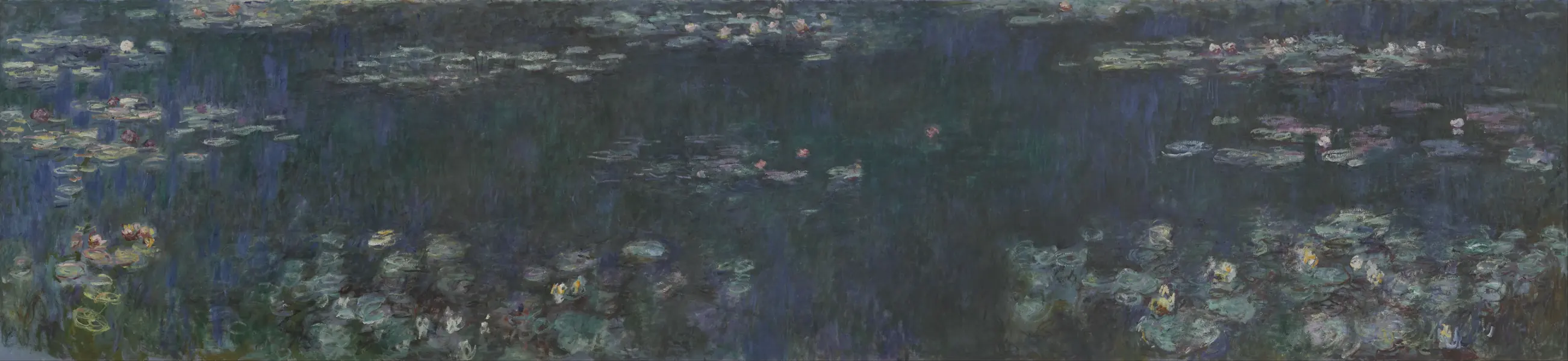
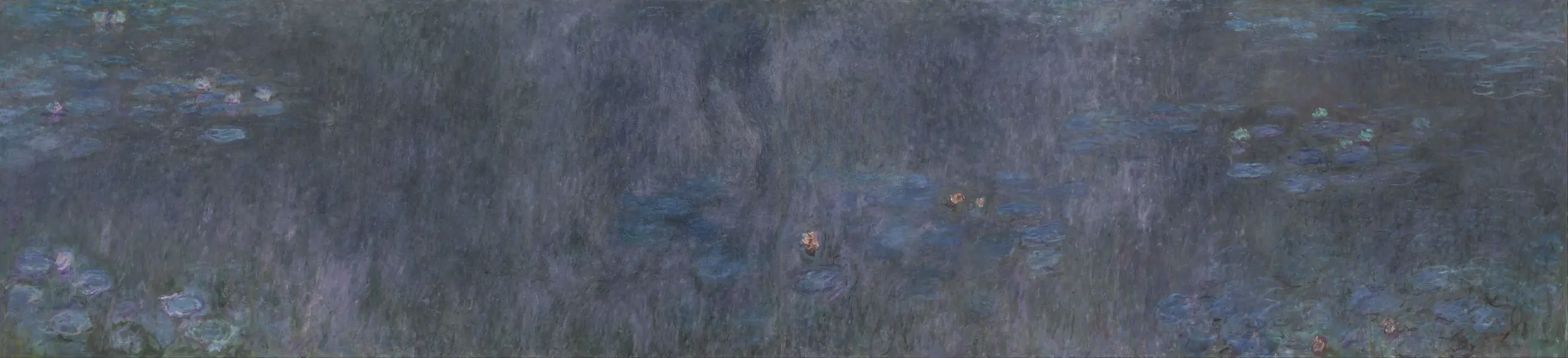
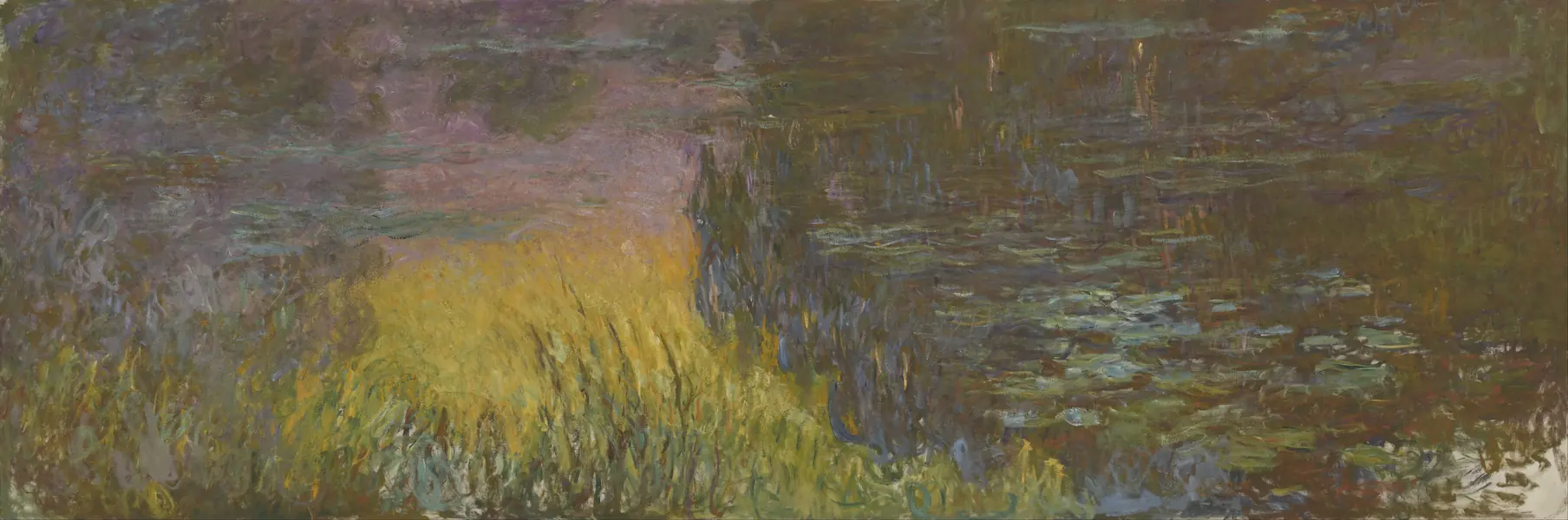
The Water-Lily Pond, Claude Monet, 1899. The National Gallery, London.
This looks like an ordinary portrait of a wealthy couple...
Jan van Eyck c. 1390–1441The Arnolfini Portrait, 1434Oil on oak · 82.2 × 60 cm · The National Gallery, London
The Arnolfini Portrait by Jan van Eyck (c. 1390–1441) is one of the most mysterious paintings ever created.
Every object seems intentional. Every reflection raises new questions. And nearly 600 years later, historians still can’t agree on what this painting is really about.
The mirror might be its greatest secret...
Who do you think the second figure in the reflection is?
Hans Holbein the Younger c. 1497–1543The Ambassadors, 1533Oil on oak · 207 × 209.5 cm · The National Gallery, London
At first glance, The Ambassadors looks like a portrait of two wealthy and powerful men, surrounded by objects representing knowledge, science, music, and exploration.
But across the bottom of the painting, Holbein placed something strange — a stretched, almost unrecognizable shape.
Viewed from the correct position, it transforms into a human skull.
The effect was created using anamorphosis, a technique in which an image is deliberately distorted so that it can only be seen properly from a particular angle.
But the skull is more than an optical illusion. It is a memento mori — a reminder of death and the temporary nature of earthly life.
Among all the symbols of wealth, knowledge, achievement, and power, Holbein placed death in plain sight.
A reminder that no matter what we own, learn, or accomplish, none of it lasts forever.
And perhaps that is what makes the illusion so perfect: death was there all along — you just had to know how to look.
A giant fish. A man eating an enormous strawberry. And a flower sticking out of someone’s butt.
Hieronymus Bosch c. 1450–1516The Garden of Earthly Delights, c. 1490–1500Oil on oak panels · 205.5 × 384.9 cm · Museo del Prado, Madrid
At first glance, it’s overwhelming. Look closer, and it only gets stranger.
Painted around 1490–1510, Bosch’s famous triptych takes us through three extraordinary worlds: the Garden of Eden, a surreal landscape filled with earthly pleasures, and finally, a nightmarish vision of Hell.
Giant fruits, impossible creatures, mysterious structures and tiny bizarre scenes are hidden everywhere — and almost nothing is there by accident.
Before earthly pleasures and Hell, there was Paradise.
The left panel of Bosch’s famous triptych takes us to the Garden of Eden, where Christ presents Eve to Adam. But look closer, and this seemingly perfect world begins to feel strangely unsettling.
An owl hides inside the Fountain of Life. Predators hunt their prey. Strange creatures inhabit the landscape. Even Adam’s gaze has inspired questions about what Bosch might already be hinting at.
Perhaps Paradise was never quite as peaceful as it seemed.
The Garden of Earthly Delights, Hieronymus Bosch, c. 1490–1500
More stories under the lilies
Seventeen more of her stories lie under the water. Look through them with the arrows, or drag the pond, and raise the one you want.Seventeen more of her stories lie under the water. Look through them with the arrows, or swipe the pond, and raise the one you want.
Seventeen more of her reels. Open any painting to look closer.
This may be one of the most beautiful paintings of a death ever made...
John Everett Millais 1829–1896Ophelia, 1851–52Oil on canvas · 76.2 × 111.8 cm · Tate Britain, London
Did you know that this masterpiece isn’t actually about the wave?
Katsushika Hokusai 1760–1849Under the Wave off Kanagawa (The Great Wave), c. 1830–32Woodblock print; ink and colour on paper · 25.7 × 37.9 cm · The Metropolitan Museum of Art, New York
Ivan Shishkin 1832–1898Morning in a Pine Forest, 1889Oil on canvas · 139 × 213 cm · State Tretyakov Gallery, MoscowThe bears were painted by Konstantin Savitsky.
This may be one of the most beautiful paintings of a death ever made...
John Everett Millais 1829–1896Ophelia, 1851–52Oil on canvas · 76.2 × 111.8 cm · Tate Britain, London
At first glance, Ophelia feels almost peaceful — a young woman floating among flowers, surrounded by lush nature. But Millais is actually capturing one of the most tragic moments in Shakespeare’s Hamlet: Ophelia’s death.
And almost nothing around her is there by accident. The flowers become part of the story themselves — poppies symbolize death, violets are associated with faithfulness and innocence, while the willow represents forsaken love.
Even the creation of the painting has a story of its own. Millais’ model, Elizabeth Siddal, spent hours posing fully clothed in a bathtub so he could capture Ophelia floating in the water.
This is a painting where beauty, love and death exist almost impossibly close together.
This painting might not actually be about the girl in the center...
Diego Velázquez 1599–1660Las Meninas, 1656Oil on canvas · 318 × 276 cm · Museo del Prado, Madrid
At first glance, Infanta Margarita seems to be the obvious subject of the painting. She stands brightly lit at its center, surrounded by her attendants.
But then things get strange.
Velázquez painted himself on the left, standing in front of a huge canvas — yet we can only see the back of it. We don’t actually know what he is painting. He looks out toward the space in front of the scene, almost directly at us.
And on the wall behind him is a tiny mirror reflecting King Philip IV and Queen Mariana of Spain.
One famous interpretation is that the King and Queen are standing outside the painted scene, roughly where we, the viewers, stand — and that Velázquez may actually be painting their portrait. But we can’t know for certain. The mirror could also be reflecting a portrait already painted on his canvas, and scholars have debated the scene for centuries.
That uncertainty is exactly what makes Las Meninas so fascinating: are we looking at the subject of the painting… or are we standing in their place?
Rembrandt van Rijn 1606–1669The Night Watch, 1642Oil on canvas · 379.5 × 453.5 cm · Rijksmuseum, Amsterdam
The painting we know today is not the complete composition Rembrandt created.
In 1715, The Night Watch was moved from the Kloveniersdoelen — the headquarters of Amsterdam’s civic guard — to the Town Hall on Dam Square, now the Royal Palace. But the enormous canvas was too large for its intended place between two doors.
Instead of finding another location, sections of the canvas were cut away to make it fit. The largest strip — around 60 centimetres — was removed from the left, erasing two figures entirely. Smaller sections were also removed from the top, bottom and right. None of the missing pieces has ever been recovered.
We know what the complete composition probably looked like thanks to a smaller 17th-century copy attributed to Gerrit Lundens. In 2021, the Rijksmuseum used that copy and artificial intelligence to reconstruct the missing sections.
Would you ever cut a Rembrandt just to make it fit a wall?
Jacques-Louis David 1748–1825The Death of Marat, 1793Oil on canvas · 165 × 128 cm · Royal Museums of Fine Arts of Belgium, Brussels
Jean-Paul Marat wasn’t just the victim of a shocking murder — he was one of the most radical and controversial voices of the French Revolution.
As France descended into political violence, Marat became closely associated with the radical Jacobins and fiercely attacked their political opponents, the Girondins.
Charlotte Corday, a 24-year-old woman sympathetic to the Girondin cause, believed that Marat was helping fuel the bloodshed tearing France apart. She became convinced that killing him could help stop further violence.
On July 13, 1793, she went to his home. Marat suffered from a severe skin condition and often worked from his bathtub. Corday managed to gain access to him by claiming she had information concerning his political enemies.
Once inside, she stabbed him in the chest.
David painted The Death of Marat only months later — and included Corday’s letter still resting in Marat’s hand, forever connecting his killer to the scene.
Ironically, Corday hoped Marat’s death would help end the violence. Instead, his assassination turned him into a powerful symbol of the Revolution.
Did you know that this masterpiece isn’t actually about the wave?
Katsushika Hokusai 1760–1849Under the Wave off Kanagawa (The Great Wave), c. 1830–32Woodblock print; ink and colour on paper · 25.7 × 37.9 cm · The Metropolitan Museum of Art, New York
Most people look at this famous woodblock print and only see a massive, terrifying ocean. But if you look closely past the storm, the real subject is hiding right in the background: Mount Fuji.
Hokusai didn’t create this to show off a storm. This print is actually part of a larger collection called “Thirty-Six Views of Mount Fuji.” The mountain is the intellectual and spiritual heart of the entire artwork.
The Wave: Represents pure chaos. It is violent, moving dangerously fast, and will crash and disappear in a matter of seconds. It shows everything in life that is temporary.
The Mountain: Represents absolute stillness, peace, and eternity. It sits perfectly calm and unmoving in the background.
Whether you look at it as a historical symbol of the unshakable soul of Japan, or as a universal metaphor for staying calm through life’s personal storms — it is easily one of the smartest compositions in art history.
Did you notice Mount Fuji the first time you saw this painting, or did the massive wave trick you too?
Peter Paul Rubens 1577–1640Saturn Devouring a Son, 1636–38Oil on canvas · 180 × 87 cm · Museo del Prado, Madrid
Francisco Goya 1746–1828Saturn Devouring His Son, c. 1819–23Mural transferred to canvas · 143.5 × 81.4 cm · Museo del Prado, Madrid
Both paintings depict the same terrifying myth.
Saturn — the Roman equivalent of the Greek Titan Cronus — learned of a prophecy that one of his children would eventually overthrow him, just as he had overthrown his own father.
Determined to prevent it, he swallowed each of his children as soon as they were born.
But his wife Rhea managed to save their youngest son, Jupiter, by hiding him and giving Saturn a stone wrapped like a baby instead. Zeus eventually grew up, forced his father to release his siblings, and fulfilled the prophecy by overthrowing him.
Nearly two centuries apart, Rubens and Goya turned the same myth into two very different visions of horror.
And in the end, Saturn’s attempt to escape his fate was exactly what failed to prevent it.
Unknown artistThe White Angel, detail of The Myrrhbearers at Christ’s Tomb, c. 1235Fresco · Mileševa Monastery, near Prijepolje, Serbia
The White Angel is not an independent painting, but part of a larger fresco inside Mileševa Monastery, near Prijepolje in Serbia.
The scene depicts the women who came to Christ’s tomb after the Crucifixion. Instead of finding his body, they encounter an angel dressed in white, pointing towards the empty tomb and announcing the Resurrection.
In the 16th century, a new fresco was painted over the original composition. According to a popular legend, a monk deliberately concealed the White Angel to protect it from Ottoman soldiers, who were believed to damage the faces and eyes of Christian figures.
The later layer was eventually damaged by fire, but it also helped preserve the medieval painting beneath it. Centuries later, during restoration, the damaged upper layers were removed — and the White Angel was brought back to light.
The fresco went on to become one of the most recognisable images of Serbian medieval art. A widely repeated account claims that it appeared in an early satellite transmission between Europe and North America as a symbol of peace.
Hidden for centuries, the White Angel now continues to deliver the same message it carried in the 13th century: hope, peace and resurrection.
Grant Wood 1891–1942American Gothic, 1930Oil on beaverboard · 78 × 65.3 cm · The Art Institute of Chicago
Few paintings have been parodied as often as American Gothic. Its instantly recognizable pose has made its way into pop culture again and again — from The Simpsons and The Muppets to SpongeBob SquarePants, The Rocky Horror Picture Show, Desperate Housewives, The Simple Life, and countless advertisements, cartoons and recreations.
But the famous pair weren’t actually husband and wife.
Wood asked his sister, Nan Wood Graham, to pose as the woman, while the man was modeled by his dentist, Dr. Byron McKeeby. Wood imagined them as the kind of people who might live in the Iowa house behind them.
And when the painting first appeared, not everyone was amused.
Some viewers saw those stern faces and rigid poses as a satire of rural Midwestern life — even an unflattering caricature of small-town Americans. Wood rejected the idea that he was simply mocking them and later emphasized his respect for the rural America he portrayed.
That ambiguity never completely disappeared.
Was American Gothic making fun of rural America, or celebrating its seriousness, resilience and traditional values?
Nearly a century later, art historians still debate Wood’s intentions.
Edvard Munch 1863–1944The Scream, 1893Tempera and crayon on cardboard · 91 × 73.5 cm · National Museum, Oslo
The figure in The Scream may not be screaming at all.
Munch described the experience that inspired the painting: he was walking with two friends at sunset when the sky suddenly turned blood red. Feeling tired and overwhelmed by anxiety, he stopped while his friends continued walking.
Standing there, he wrote that he felt “a great scream through nature.”
That changes the way we can look at the figure. His hands may not simply emphasize a scream coming from his own mouth — they can be seen as a reaction to something overwhelming around him, as if he is trying to shut it out.
The distorted landscape, blood-red sky and almost wave-like figure turn that feeling of anxiety into something visible.
Perhaps that’s what makes The Scream so unsettling: the terror isn’t just inside him — it seems to consume the entire world around him.
Did you see the painting differently after knowing this?
Vincent van Gogh 1853–1890The Potato Eaters, 1885Oil on canvas · 82 × 114 cm · Van Gogh Museum, Amsterdam
Vincent van Gogh 1853–1890The Starry Night, 1889Oil on canvas · 73.7 × 92.1 cm · The Museum of Modern Art, New York
The Van Gogh we recognize instantly — vivid colors, swirling skies, expressive brushstrokes — wasn’t always the Van Gogh who painted.
His early works from the Netherlands were remarkably different: dark, earthy and subdued. He painted peasants, workers and scenes of rural life, often using browns, greys and deep greens.
Everything began to change after he moved to Paris in 1886. There, he encountered Impressionism and Neo-Impressionism, experimented with brighter colors and looser brushwork, and became fascinated by Japanese prints. His palette gradually transformed — and so did the way he painted.
Within just a few years, those dark, restrained paintings gave way to the intense color, movement and expressive brushwork we now immediately associate with his name.
Same artist. An almost completely different visual world.
There may be a hidden message in this famous painting...
Michelangelo 1475–1564The Creation of Adam, c. 1511Fresco · 280 × 570 cm · Sistine Chapel, Vatican City
Could one of the most famous scenes in art contain a hidden image of the human brain?
First presented in medical literature in 1990, this theory has since been examined and debated by researchers and medical experts. They have identified possible similarities not only in the outline surrounding God, but also in details resembling the brain’s internal anatomy.
And the idea may not be as unlikely as it sounds. Michelangelo studied the human body through dissections and possessed an extraordinary knowledge of anatomy.
If the resemblance was intentional, the meaning of the scene becomes even more powerful: perhaps God was giving Adam not only life, but the human mind itself.
It remains a theory — but once you see it, it is difficult to unsee.
Her beautiful wedding dress hides a much darker story...
Vasily Pukirev 1832–1890The Unequal Marriage, 1862Oil on canvas · 173 × 136.5 cm · State Tretyakov Gallery, Moscow
The bride’s dress is beautiful. Her face tells another story. Beside her stands a much older, wealthy groom; around her, the wedding goes on as though her wishes do not matter.
Now look at the far right of the painting. The dark-haired man with folded arms is believed to be Pukirev himself. One story says he loved the woman who inspired the bride and painted himself watching her marry another man. Other accounts tell a different story, so we cannot know exactly how personal this scene was to him.
What the painting makes impossible to ignore is the bride’s lack of choice. Forced marriage is still a reality today. We should stand with the girls and women fighting for the right to decide their own futures.
Gustav Klimt 1862–1918Hygieia, detail of Medicine (destroyed in 1945), 1900–07Oil on canvas · Destroyed by fire at Schloss Immendorf, 1945
Gustav Klimt 1862–1918The Kiss, 1907–08Oil and gold leaf on canvas · 180 × 180 cm · Belvedere, Vienna
When we think of Klimt, we usually think of gold, intricate patterns, sensual figures and, of course, The Kiss. But his art didn’t always look like that.
Over the course of his career, Klimt moved through remarkably different styles — from highly detailed academic drawings inspired by classical art, to atmospheric landscapes that can almost be mistaken for Impressionist works, and later to increasingly colorful and experimental compositions.
His famous Golden Phase may have become his signature, but it represents only one chapter of a much more diverse artistic career.
Sometimes, looking at Klimt’s works side by side, it’s hard to believe they were all made by the same person.
John William Waterhouse 1849–1917Ulysses and the Sirens, 1891Oil on canvas · 100.6 × 202 cm · National Gallery of Victoria, Melbourne
John William Waterhouse 1849–1917Hylas and the Nymphs, 1896Oil on canvas · 98.2 × 163.3 cm · Manchester Art Gallery
Five years before painting Hylas and the Nymphs, Waterhouse had already painted the famous episode from Homer’s Odyssey: Odysseus tied to the mast while the Sirens try to lure him to them with their song.
In Greek mythology, Hylas was a young companion of Heracles. While fetching water, he encountered a group of water nymphs who were captivated by his beauty. They drew him into the water — and Hylas was never seen again.
It’s easy to see why the scene feels strangely familiar: beautiful supernatural beings, an irresistible attraction, and a man being drawn toward the water.
But unlike Odysseus, Hylas had no ropes to save him.
Different creatures. Different myths. But two dangerously irresistible encounters — painted by the same artist.
Ivan Shishkin 1832–1898Morning in a Pine Forest, 1889Oil on canvas · 139 × 213 cm · State Tretyakov Gallery, MoscowThe bears were painted by Konstantin Savitsky.
Few artists could paint a forest quite like Ivan Shishkin.
One of the great masters of Russian landscape painting, Shishkin became famous for his incredibly detailed depictions of nature — towering pines, dense forests, sunlight breaking through the trees, and landscapes that somehow feel almost more real than reality.
He studied nature obsessively, paying attention to individual trees, plants, roots and even the texture of bark. His forests weren’t just backgrounds — they were the main characters.
Perhaps his most famous work, Morning in a Pine Forest (1889), is instantly recognizable because of its bears. But look past them, and you’ll see what Shishkin truly mastered: the forest itself.
Genaro Pérez Villaamil 1807–1854View of the Interior of a Cathedral, c. 1850Oil on canvas
Angelo Inganni 1807–1880Nocturne of Piazza del Duomo, Milan, 19th centuryOil on canvas
An imagined Gothic cathedral filled with almost obsessive detail. Towering arches, sculptures, stained glass and tiny human figures turn the architecture into something grander than reality itself.
Milan’s Duomo rising almost ghostlike against the night sky. The illuminated marble, countless Gothic spires and tiny figures crossing the square make the cathedral feel both real and otherworldly.
Paintings so detailed that, for a moment, you might forget there’s a canvas between you and them.
Claude Monet 1840–1926The Water-Lily Pond, 1899Oil on canvas · 88.3 × 93.1 cm · The National Gallery, London
Claude Monet (1840–1926) didn’t have to travel far to find inspiration.
At his home in Giverny, he transformed the land into the water garden that would become one of his greatest sources of inspiration — complete with a pond, water lilies, and the now-famous Japanese bridge.
For decades, the garden kept appearing on his canvases in different light, seasons, and moods.
Seven centuries of painting, from the White Angel, painted around 1235, to American Gothic in 1930. Walk through, room by room.Swipe through them, room by room.
c.1235
Early Netherlandish paintingThe Middle AgesEarly Netherlandish paintingThe High RenaissanceThe Northern RenaissanceThe BaroqueRevolution and RomanticismPre-Raphaelites and RealismImpressionism and afterAmerica, 1930
The Middle Ages
5th to 15th century
In Serbia’s medieval monasteries, painters worked in fresco, laying pigment into wet lime plaster.
Unknown artistThe White Angel, c. 1235
“Hidden for centuries, the White Angel now continues to deliver the same message it carried in the 13th century: hope, peace and resurrection.”
c. 1235
Early Netherlandish painting
c. 1420–1520
In the Low Countries, painters built up thin layers of oil paint to render light, fabric and reflections in fine detail.
Jan van EyckThe Arnolfini Portrait, 1434
“The mirror might be its greatest secret...”
1434
Hieronymus BoschThe Garden of Earthly Delights, c. 1490–1500
“Look closer, and it only gets stranger.”
c. 1490–1500
The High Renaissance
c. 1490–1527
In Florence and Rome, artists studied anatomy and ancient sculpture, and popes commissioned vast frescoes.
MichelangeloThe Creation of Adam, c. 1511
“Could one of the most famous scenes in art contain a hidden image of the human brain?”
c. 1511
The Northern Renaissance
16th century
North of the Alps, painters joined Netherlandish detail with ideas from Italy, in the age of print and the Reformation.
Hans Holbein the YoungerThe Ambassadors, 1533
“Among all the symbols of wealth, knowledge, achievement, and power, Holbein placed death in plain sight.”
1533
The Baroque
c. 1600–1750
Painters staged their scenes with strong contrasts of light and shadow, known as chiaroscuro.
Peter Paul RubensSaturn Devouring a Son, 1636–38
“Determined to prevent it, he swallowed each of his children as soon as they were born.”
1636–38
Rembrandt van RijnThe Night Watch, 1642
“The painting we know today is not the complete composition Rembrandt created.”
1642
Diego VelázquezLas Meninas, 1656
“He looks out toward the space in front of the scene, almost directly at us.”
1656
Revolution and Romanticism
c. 1789–1850
Painters turned to revolution, nightmares and the sublime, and in Japan the woodblock print reached a wide public.
Jacques-Louis DavidThe Death of Marat, 1793
“David painted The Death of Marat only months later — and included Corday’s letter still resting in Marat’s hand, forever connecting his killer to the scene.”
1793
Francisco GoyaSaturn Devouring His Son, c. 1819–23
“Nearly two centuries apart, Rubens and Goya turned the same myth into two very different visions of horror.”
c. 1819–23
Katsushika HokusaiUnder the Wave off Kanagawa (The Great Wave), c. 1830–32
“But if you look closely past the storm, the real subject is hiding right in the background: Mount Fuji.”
c. 1830–32
“Paintings so detailed that, for a moment, you might forget there’s a canvas between you and them.”
Genaro Pérez VillaamilView of the Interior of a Cathedral, c. 1850
“An imagined Gothic cathedral filled with almost obsessive detail.”
c. 1850
Angelo InganniNocturne of Piazza del Duomo, Milan, 19th century
“Milan’s Duomo rising almost ghostlike against the night sky.”
19th century
Pre-Raphaelites and Realism
c. 1848–1900
In London, the Pre-Raphaelites painted nature leaf by leaf; in Russia, realists painted the land and everyday life.
John Everett MillaisOphelia, 1851–52
“This is a painting where beauty, love and death exist almost impossibly close together.”
1851–52
Vasily PukirevThe Unequal Marriage, 1862
“Her face tells another story.”
1862
Ivan ShishkinMorning in a Pine Forest, 1889
“His forests weren’t just backgrounds — they were the main characters.”
1889
“Different creatures. Different myths. But two dangerously irresistible encounters — painted by the same artist.”
John William WaterhouseUlysses and the Sirens, 1891
“Remember the sirens from The Odyssey?”
1891
John William WaterhouseHylas and the Nymphs, 1896
“But unlike Odysseus, Hylas had no ropes to save him.”
1896
Impressionism and after
c. 1870–1910
Painters took their easels outdoors to catch changing light, then pushed colour and line to express feeling.
“Same artist. An almost completely different visual world.”
Vincent van GoghThe Potato Eaters, 1885
“His early works from the Netherlands were remarkably different: dark, earthy and subdued.”
1885
Vincent van GoghThe Starry Night, 1889
“Everything began to change after he moved to Paris in 1886.”
1889
Edvard MunchThe Scream, 1893
“The figure in The Scream may not be screaming at all.”
1893
Claude MonetThe Water-Lily Pond, 1899
“One garden. Hundreds of paintings.”
1899
“Sometimes, looking at Klimt’s works side by side, it’s hard to believe they were all made by the same person.”
Gustav KlimtHygieia, 1900–07
“Does this woman remind you of someone?”
1900–07
Gustav KlimtThe Kiss, 1907–08
“When we think of Klimt, we usually think of gold, intricate patterns, sensual figures and, of course, The Kiss.”
1907–08
America, 1930
The 1930s
During the Great Depression, Regionalist painters turned to the farms and small towns of the American Midwest.
Grant WoodAmerican Gothic, 1930
“But the famous pair weren’t actually husband and wife.”
1930
True size
Every painting with a known size, hung on one wall at its real size, beside a visitor of your height.
Every painting with a known size, at its real size along the bank of the pond at dusk, from Hokusai’s print to The Night Watch. Slide the hook along the picture rail and a visitor of your height walks beside them.
cm
The Great WaveKatsushika Hokusai25.7 × 37.9 cm
The Arnolfini PortraitJan van Eyck82.2 × 60 cm
American GothicGrant Wood78 × 65.3 cm
The ScreamEdvard Munch91 × 73.5 cm
The Starry NightVincent van Gogh73.7 × 92.1 cm
The Water-Lily PondClaude Monet88.3 × 93.1 cm
OpheliaJohn Everett Millais76.2 × 111.8 cm
The Potato EatersVincent van Gogh82 × 114 cm
Saturn Devouring His SonFrancisco Goya143.5 × 81.4 cm
Saturn Devouring a SonPeter Paul Rubens180 × 87 cm
Hylas and the NymphsJohn William Waterhouse98.2 × 163.3 cm
Ulysses and the SirensJohn William Waterhouse100.6 × 202 cm
The Death of MaratJacques-Louis David165 × 128 cm
The Unequal MarriageVasily Pukirev173 × 136.5 cm
Morning in a Pine ForestIvan Shishkin139 × 213 cm
The KissGustav Klimt180 × 180 cm
The AmbassadorsHans Holbein the Younger207 × 209.5 cm
The Garden of Earthly DelightsHieronymus Bosch205.5 × 384.9 cm
Las MeninasDiego Velázquez318 × 276 cm
The Creation of AdamMichelangelo280 × 570 cm
The Night WatchRembrandt van Rijn379.5 × 453.5 cm
You, 170 cm
Under the Wave off Kanagawa (The Great Wave)Katsushika Hokusai, c. 1830–32 · 25.7 × 37.9 cm
Centres hung at 150 cm, the usual gallery eye line; the largest works are raised to stay 30 cm off the floor. The Creation of Adam is a fresco on the Sistine Chapel ceiling.
The Notebook
Longer stories, one painting at a time, with the details marked on the canvas.